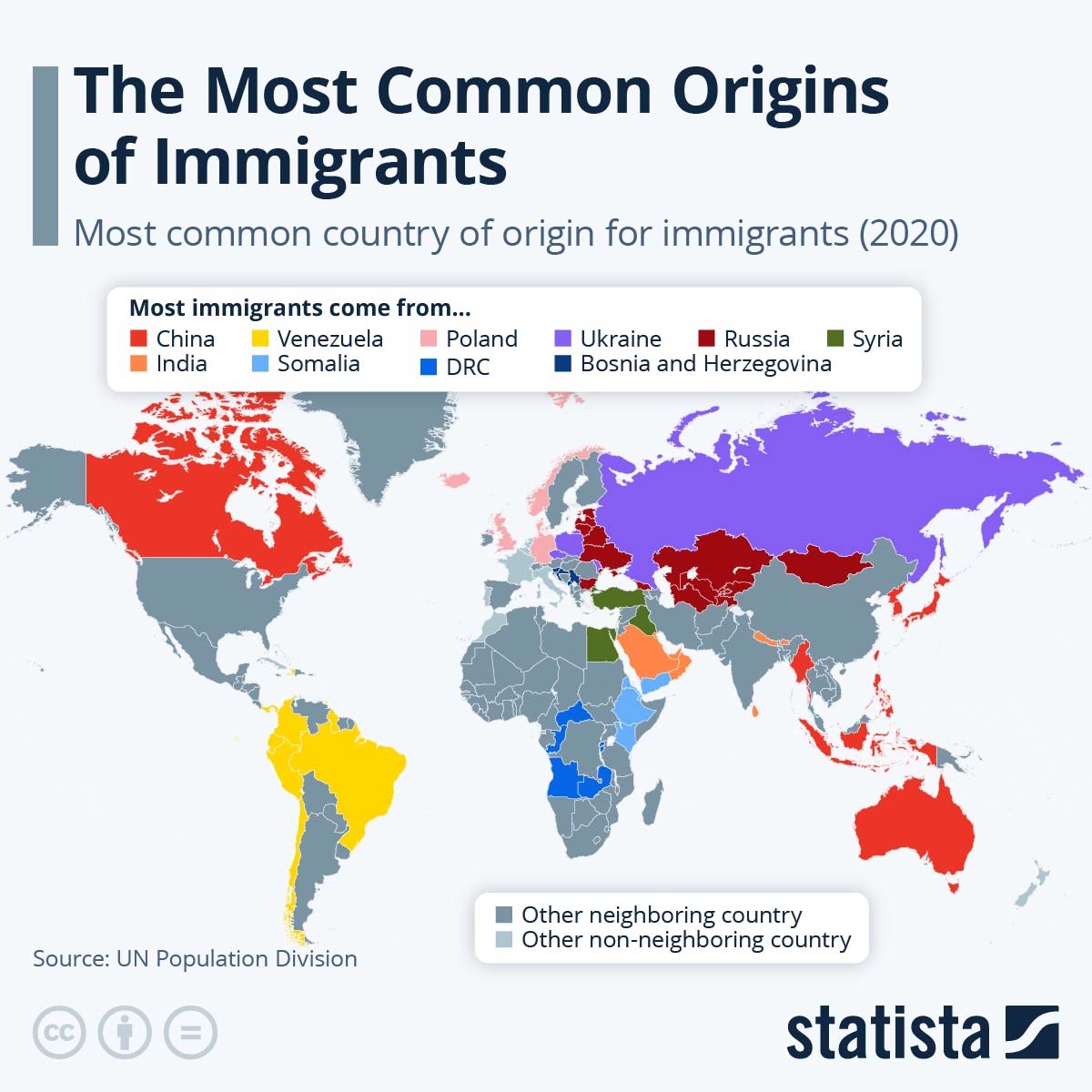
Below is a world map showing the most common origins of immigrants by country, based on data from the United Nations Population Division. The map reveals some prolific immigrant nations as well as the influence that conflict and economic collapse can have on migration patterns.
Globally, migration patterns most often reflect geographic proximity, with neighboring countries serving as each other’s primary sources of immigrants. This is evident in relationships such as the United States and Mexico, Albania and Greece, and Honduras and El Salvador.
However, this pattern can shift dramatically when large numbers of people are displaced by conflict, war, or economic hardship. Venezuelans have become the largest immigrant group in nine neighboring countries, while citizens of the Democratic Republic of the Congo make up significant immigrant populations in six surrounding nations. Somali migrants dominate immigrant populations across all five of Somalia’s neighboring countries. By 2020, Ukrainian immigrants were already the largest group in four neighboring states, a level comparable to that of Syrian and Bosnian migrants in their regions.
Some countries, however, consistently send migrants far beyond their immediate neighbors. India and China are notable examples, with their citizens forming major immigrant populations both regionally and globally. Poland stands out as a leading source of emigration, with Polish nationals representing the largest immigrant group in the United Kingdom, Germany, and several Scandinavian countries.
A small number of countries have a primary immigrant group that does not come from a neighboring nation, often reflecting historical colonial ties. For example, immigrants from France constitute the largest group in Equatorial Guinea and Morocco; Surinamese in the Netherlands; Angolans in Portugal; Algerians in France; Spaniards in Cuba; and Britons in New Zealand.
Original Source: https://www.statista.com/chart/33303/most-common-country-of-origin-for-immigrants/
You might also like…